Learn when SSR improves content delivery, where CSR or static rendering may be more efficient, and how U.S. businesses can choose the right approach.
A web application can feel slow even when its design is polished. Users may wait for JavaScript to download before meaningful content appears, search engines may receive a minimal initial document, and teams may struggle to balance dynamic data with fast delivery. Server-Side Rendering addresses part of that problem by generating page HTML on the server before it reaches the browser.
For U.S. organizations, the decision should not be framed as “SSR is modern, therefore we need it.” Server-Side Rendering introduces server work, caching decisions and infrastructure considerations that may be unnecessary for static pages or private applications. The right rendering model depends on content freshness, personalization, search visibility, interaction patterns and the performance characteristics that matter to the business.
What Server-Side Rendering Actually Does
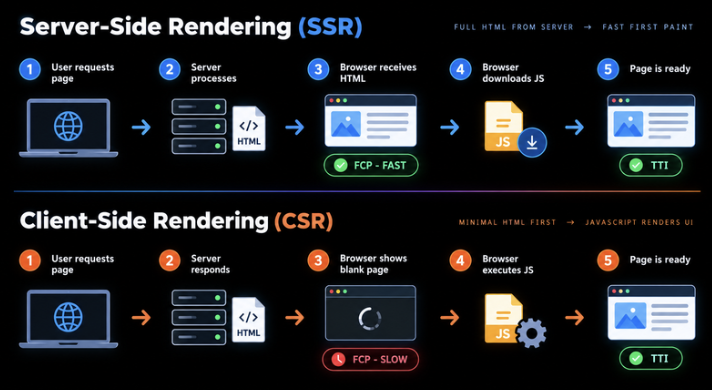
With Server-Side Rendering, the server prepares HTML for a request and sends that rendered document to the browser. The browser can display meaningful content before client-side JavaScript finishes making the page fully interactive. In frameworks such as Next.js, server rendering can happen at request time, while other pages may be generated statically ahead of time and reused.
This distinction matters because SSR, static generation and client-side rendering solve different problems. A modern application does not need to use one method everywhere. Frameworks can combine rendering strategies on a page-by-page or component-by-component basis, which makes hybrid architecture practical for content-heavy websites and interactive applications.
Teams considering the wider architecture behind rendering can also review how Full Stack Web Development creates better digital experiences across front-end, back-end, data and infrastructure decisions.
Compare SSR, CSR and Static Rendering
The SSR vs CSR discussion is useful only when the alternatives are compared against the same business requirements.
| Rendering approach | Where HTML is primarily prepared | Strong fit | Main trade-off |
|---|---|---|---|
| SSR | Server at request time | Dynamic public pages, request-specific content | More server work and potentially slower TTFB |
| CSR | Browser after JavaScript loads | Highly interactive private applications | Initial experience depends more heavily on client JavaScript |
| Static generation | Build time or controlled revalidation | Marketing pages, articles, documentation | Less suitable for content that must change on every request |
| Hybrid | Combination of approaches | Larger digital products with mixed requirements | More architectural decisions and testing |
Static rendering can often be served efficiently from caches or CDNs because the same HTML can be reused. Request-time rendering is more suitable when the page cannot be prepared ahead of a user’s request, but it creates work for the server on each uncached request. Next.js documentation explicitly notes this trade-off.
The best rendering strategy is normally the simplest one that satisfies freshness, personalization and user-experience requirements.
When Server-Side Rendering Improves the User Experience
Server-Side Rendering is particularly useful when meaningful page content should be available quickly and that content depends on request-time information.
Consider an ecommerce category page where availability, pricing or merchandising rules change frequently. If the page depends entirely on client-side requests, the browser may first load a shell and then wait for additional JavaScript and API responses. A server-rendered response can deliver useful HTML earlier, while JavaScript subsequently enables filtering, account functions and richer interactions.
The same principle can apply to:
- public product and service pages with frequently changing data;
- location-specific pages;
- authenticated experiences where request-specific content must be prepared before display;
- marketplaces with dynamic inventory;
- media or publishing platforms with rapidly updated content.
The benefit depends on the complete request path. Slow databases or third-party APIs can still delay a rendered response. Moving work to the server does not remove performance problems; it changes where they occur.
The guide on why website speed matters for businesses provides additional context for treating performance as a commercial requirement rather than a purely technical metric.
SEO Benefits Need to Be Understood Correctly
Server-Side Rendering can make primary content available directly in the initial HTML, which can simplify how content is delivered to crawlers and link-preview services. However, it is inaccurate to assume that client-side rendering automatically prevents Google from indexing a website.
Google’s March 2026 Search documentation update states that Google Search has been rendering JavaScript for multiple years and that using JavaScript to load content is not, by itself, making it harder for Google Search.
That changes the decision. Choose SSR because it supports the required experience and content-delivery model, not because of an outdated belief that every JavaScript-driven page is invisible to search engines.
SEO-focused public pages still need correct metadata, internal linking, HTTP status behavior, structured content and reliable performance regardless of rendering model. Rendering is one architectural input, not an SEO strategy on its own.
Content-heavy organizations may also need to decide how rendering interacts with the CMS. The comparison of headless CMS and traditional CMS can help teams think through how content delivery and front-end architecture should work together.
Where Server-Side Rendering Can Add Unnecessary Complexity
SSR is not automatically the fastest or cheapest approach. Request-time rendering can increase server compute, introduce caching complexity and make response time dependent on databases or external services.
It may be unnecessary when:
- content changes infrequently and can be generated statically;
- the application is private and SEO is irrelevant;
- most data becomes useful only after authentication;
- the browser must remain highly interactive after initial load;
- cached static pages already meet performance goals;
- the team lacks the operational capability to monitor server-rendered infrastructure.
A private analytics dashboard is a common example. If every user sees highly personalized data and the application is not intended for public search, client-side data fetching can be entirely appropriate. Next.js documentation uses user dashboards as an example where client-side rendering can work well because SEO is not relevant and data changes frequently.
Adding request-time rendering to every route can increase cost without producing a meaningful customer benefit.
Hydration and Interactivity Still Matter
Receiving HTML from the server is only part of the experience. Interactive JavaScript applications usually need to attach client-side behavior after the HTML arrives. This process is commonly called hydration. Next.js describes pre-rendered HTML being combined with the JavaScript needed to make the page fully interactive.
A server side rendering website can therefore appear visually complete before every control is ready to respond. Large JavaScript bundles, expensive components and excessive client-side work can still create delays.
SSR web development should therefore consider:
- how much JavaScript is sent to the browser;
- which components genuinely need client-side behavior;
- whether data fetching creates waterfalls;
- whether third-party scripts delay interaction;
- how loading and error states behave;
- how server and client data stay consistent.
Fast HTML delivery and fast interactivity are related goals, but they are not the same goal.
U.S. Scenario: A National Ecommerce Business
Consider a retailer serving customers across multiple U.S. states with thousands of public product and category pages. Prices, stock status and promotions can change throughout the day, while organic search and paid campaigns drive substantial traffic to landing pages.
Server-Side Rendering could be appropriate for selected dynamic pages where fresh, crawlable content needs to arrive with the initial response. Static generation or revalidation may still be better for editorial pages, evergreen buying guides and other content that does not need request-time computation.
The business should also consider geographic infrastructure, caching, inventory APIs and failure behavior. If an inventory service is temporarily slow, the rendering architecture should avoid allowing that dependency to degrade every page response.
Where the platform requires extensive tailoring, the benefits of custom website development can help frame the broader build and architecture decision.
U.S. Scenario: A B2B SaaS Platform
A U.S. SaaS company may have a public marketing site, documentation, pricing pages and an authenticated product dashboard. Treating all of these routes identically would create unnecessary constraints.
SSR may support dynamic public pages or account entry points where request-time information matters. Static generation can handle documentation and evergreen marketing content, while the authenticated dashboard may rely more heavily on client-side fetching for rapidly changing user-specific data.
This is where a hybrid strategy becomes practical. Different parts of the same product can use different rendering models without compromising architectural consistency.
Decide With Page-Level Requirements, Not a Site-Wide Rule
A practical SSR web development decision is often made at route level rather than across the entire website. Teams should classify pages by how often their data changes, whether the content is public, how personalized it is, and whether it can be cached safely.
A useful review process is:
- Identify public pages where initial content delivery is commercially important.
- Separate content that can be generated ahead of time from content that must be current on every request.
- Map personalized or authenticated routes that do not need search visibility.
- Define acceptable response-time and interactivity targets.
- Test the cost of server work, API calls and database access under realistic traffic.
- Decide where caching, static generation or client-side fetching can reduce unnecessary compute.
- Monitor real user experience after launch and adjust the rendering mix.
This approach prevents teams from turning a rendering preference into an architecture rule. The rendering model should follow the page’s job, not the framework’s marketing message.
Organizations that expect higher U.S. traffic volumes or geographic distribution should also consider how server rendering interacts with hosting, caching and deployment. The guide to cloud development for Chicago businesses provides additional context for matching cloud architecture to digital operations.
Security, Reliability and Operational Ownership
Rendering on the server means more application work may happen in infrastructure the business must operate and monitor. Teams should consider request authentication, secrets, API access, cache behavior, logging, error handling and dependency updates alongside performance.
A poorly handled server error can affect the whole page response, while a slow dependency can become a bottleneck across many requests. Resilient designs should define timeouts, fallbacks and observability for critical data sources.
The guide on protecting your website from cyber attacks provides additional context for securing web applications across infrastructure, dependencies and application layers.
Operational readiness matters as much as framework capability. If the internal team cannot monitor, troubleshoot and maintain the rendering environment, the architecture may become harder to support than a simpler static or client-rendered alternative.
For organizations deciding whether that capability should sit internally or with a specialist partner, the comparison of in-house versus outsourced website development can help frame the resourcing decision.
How Dev Centre House Can Support SSR Delivery in the United States
Dev Centre House can support U.S. organizations with discovery, architecture assessment, front-end and back-end development, API integration, performance engineering, testing and cloud planning.
For a Server-Side Rendering project, the work can begin by identifying which user journeys genuinely benefit from request-time HTML and which pages should remain static or client-rendered. The architecture can then be designed around data freshness, caching, application dependencies, security and deployment requirements rather than applying one rendering strategy everywhere.
Where an existing application has become slow or difficult to maintain, the team can also assess whether the underlying issue is rendering, JavaScript weight, API latency, database design or infrastructure. This helps avoid an expensive migration that changes the rendering model without fixing the actual bottleneck.
Conclusion
Server-Side Rendering is most valuable when dynamic public content needs to arrive with meaningful HTML at request time and that benefit justifies additional server work. It is not a universal replacement for static generation or CSR.
For U.S. businesses, the strongest approach is usually hybrid: render each page according to its content, personalization and performance requirements. Start with user journeys, test the real bottlenecks, and choose SSR only where it creates a measurable improvement in delivery, discoverability or customer experience.
FAQs
1. What is Server-Side Rendering?
It is a rendering approach in which HTML is generated on the server for a request and sent to the browser before client-side JavaScript finishes adding interactivity.
2. What is the difference between SSR and CSR?
SSR prepares meaningful HTML on the server, while client-side rendering relies more heavily on JavaScript in the browser to build or populate the page after the initial response.
3. Is SSR always better for SEO?
No. Google can render JavaScript, and SEO also depends on crawlability, metadata, HTTP behavior, content quality, internal linking and performance. SSR can still be useful when making important content available directly in the initial HTML.
4. When should a business use static generation instead of SSR?
Static generation is often appropriate when content can be prepared ahead of a request and reused, such as many marketing pages, articles and documentation pages.
5. Can one website use SSR, CSR and static rendering together?
Yes. Modern frameworks can support hybrid strategies, allowing different routes or components to use the rendering model that best matches their data and user-experience requirements.