Compare server and client rendering across performance, SEO, interactivity and infrastructure to choose the right approach for U.S. digital products.
Choosing how a website renders its content affects more than development architecture. It can influence first-load performance, interactivity, infrastructure requirements, search visibility and the amount of JavaScript a browser must process. For U.S. organizations evaluating SSR vs CSR, the right approach depends on what users need to see immediately, how often data changes and where application work should happen.
Neither rendering model is universally faster. A public ecommerce category page, a B2B marketing website and an authenticated analytics dashboard have very different requirements. SSR vs CSR should therefore be treated as a page-level product decision rather than a site-wide preference.
What Changes Between Server and Client Rendering?
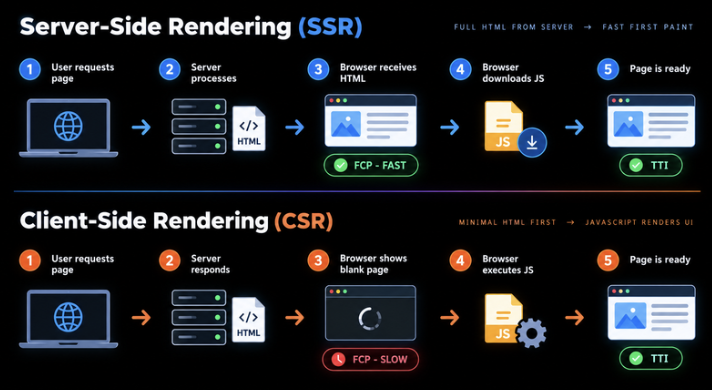
With server-side rendering, the server prepares HTML before it reaches the browser. With client-side rendering, the browser receives the application shell and JavaScript performs more of the work needed to build or populate the interface.
Modern frameworks increasingly blur that distinction. React provides separate server and client rendering APIs, while frameworks such as Next.js can combine server and client components within the same application. This makes hybrid delivery practical for products containing both public content and highly interactive account areas.
Teams considering the broader architecture can also review how Full Stack Web Development creates better digital experiences across front-end, back-end, data and infrastructure decisions.
SSR vs CSR at a Glance
| Decision area | Server-side rendering | Client-side rendering |
|---|---|---|
| Initial HTML | Generated on the server | Often minimal before JavaScript runs |
| First meaningful content | Can arrive with the response | May depend more heavily on JavaScript and data fetching |
| Interactivity | Usually requires hydration or client code | Built around browser-side interaction |
| Server workload | Higher for request-time rendering | Lower for browser-side rendering |
| Caching | Powerful but requires careful design | Static application assets are generally straightforward to cache |
| Search-focused pages | Often a strong fit | Can work, but implementation needs care |
| Highly interactive private apps | May add unnecessary server work | Often a natural fit |
| Personalization | Can occur before HTML is returned | Can occur after the application loads |
This table is a starting point rather than a verdict. The practical SSR vs CSR choice should be made against user journeys, performance targets and operational constraints.
When Server Rendering Can Improve the First Experience
Server rendering can be useful when important page content should appear in the initial response. Product pages, category pages, location pages, editorial content and other public routes may benefit when users can see meaningful HTML before the browser completes additional client-side work.
The advantage is especially relevant when visitors arrive from search, advertising or shared links and expect useful content quickly. However, request-time rendering is only as fast as the server path behind it. Slow database queries, personalization rules or third-party APIs can still delay the response.
The article on why website speed matters for businesses provides additional context for treating performance as a commercial concern rather than simply a technical metric.
Rendering on the server can improve content delivery, but it does not compensate for inefficient application architecture.
When Client Rendering Is the Better Fit
Client-side rendering can be well suited to applications where users spend significant time inside an authenticated interface and search visibility is not important. Dashboards, admin systems, collaborative tools and complex account areas often rely on continuous interaction after the initial load.
In those cases, the browser can manage state changes, filters, charts and user-specific data without requesting a newly rendered page for every interaction. Modern client frameworks can provide a responsive application experience once required assets have loaded.
CSR is not automatically the right answer for every interactive product, though. Heavy JavaScript bundles and inefficient data fetching can make the initial experience slow, particularly on less powerful devices or weaker networks.
The SSR vs CSR decision should therefore separate initial delivery performance from ongoing interaction performance. These are different stages of the same user journey.
SEO: Avoid Oversimplifying the Rendering Debate
It is common to hear that server rendering is always required for SEO. That is too simplistic. Public pages still need crawlable URLs, useful content, appropriate metadata, correct HTTP behavior and a coherent internal-link structure regardless of where rendering occurs.
Server rendering can make important content available in the initial HTML. Client-rendered implementations may require additional attention to ensure content and metadata remain consistently accessible.
For content-heavy organizations, rendering strategy also interacts with the CMS architecture. The comparison of headless CMS and traditional CMS can help teams evaluate how content management and front-end delivery should work together.
Rendering supports SEO, but it does not replace technical SEO or strong content architecture.
Hydration Is an Important Part of Server-Rendered Applications
A server-rendered React page may arrive with visible HTML, but interactive components still need browser-side JavaScript. React’s client APIs include hydrateRoot, which is used with HTML generated by server rendering to make the interface interactive.
This means a server-rendered page can appear ready before every button, menu or interactive control is fully usable. Large JavaScript bundles or expensive hydration work can therefore reduce some of the perceived benefit of server rendering.
When evaluating SSR vs CSR, teams should measure:
- time until meaningful content appears;
- time until important controls are interactive;
- JavaScript transferred and executed;
- API and database latency;
- caching effectiveness;
- hydration errors;
- performance on realistic mobile devices.
A fast-looking page and a responsive page are not always the same thing.
Infrastructure and Cost Trade-Offs Matter
Rendering more requests on a server can increase compute requirements. The impact depends on traffic, cacheability, personalization and how much work each request performs.
A mostly static marketing site may not need request-time rendering for every page. Static generation and content delivery networks can often serve reusable HTML efficiently. By contrast, a dynamic page whose content genuinely changes for each request may justify additional server computation.
CSR can shift more rendering responsibility to the user’s device and allow static application assets to be distributed efficiently, but backend APIs still require infrastructure. Moving rendering into the browser does not eliminate server costs; it changes where some of the work occurs.
U.S. organizations planning geographically distributed infrastructure may also find the guide to cloud development for Chicago businesses useful when assessing hosting, scalability and operational requirements.
U.S. Scenario: A National Ecommerce Platform
Consider a U.S. retailer serving customers across many states. Its public catalog includes category pages, product detail pages, inventory status and promotional content, while customers also have account areas for orders, returns and saved preferences.
Using one rendering approach everywhere would be unnecessary. Public product and category pages may benefit from server or static rendering so meaningful content arrives quickly and remains easy to discover. The signed-in account area may rely more heavily on client-side interaction because the content is user-specific and not intended for public search.
In this case, SSR vs CSR becomes a route-level architecture choice. The retailer can optimize public acquisition journeys differently from authenticated customer journeys while retaining a consistent design system.
Where the commerce experience requires unusual workflows or integrations, the benefits of custom website development can help frame when tailored engineering provides enough value.
U.S. Scenario: A B2B SaaS Dashboard
Consider a SaaS company with a public website, documentation, pricing pages and a highly interactive analytics product. Visitors may arrive through search to compare features, while logged-in customers spend hours filtering data and building reports.
The public pages may favor server or static rendering. The dashboard may favor more client-side behavior because it depends on authenticated data and frequent interactions.
The important lesson is that the product does not need one rendering philosophy. A hybrid model can keep search-focused content efficient while allowing complex application areas to behave like responsive software.
This is also why SSR vs CSR should be discussed alongside APIs, caching, application state and data architecture rather than in isolation.
Security and Reliability Still Span the Whole Application
Neither rendering approach removes security responsibilities. Authentication, authorization, API protection, dependency management, data handling and secure deployment remain important.
Server rendering may create additional concerns around request-time data access, secrets, caching and error handling. Client rendering can expose more application behavior to the browser and therefore depends heavily on secure APIs and robust access controls.
The guide on protecting your website from cyber attacks provides a broader framework for website and application security.
Choose rendering architecture for user and product requirements, then secure the full system around it.
Use a Hybrid Strategy When Requirements Differ by Route
Modern frameworks make mixed rendering increasingly practical. Current React guidance recommends using frameworks for production applications, and those frameworks can support client rendering, static generation and server rendering rather than forcing one model across the complete application.
That means the more useful question is often not “Which model should the website use?” but “Which model should this route use?”
A practical review can classify routes by:
- whether the content must be publicly discoverable;
- how often the data changes;
- whether the page is personalized;
- how interactive the experience is;
- whether the output can be cached safely;
- how expensive server computation is;
- what first-load and interaction targets matter.
The SSR vs CSR decision becomes more precise when teams evaluate those requirements page by page.
How Dev Centre House Can Support Rendering Strategy in the United States
Dev Centre House can support U.S. organizations with discovery, architecture assessment, front-end and back-end development, performance engineering, API integration, cloud planning and testing.
An engagement can begin by measuring the current user experience and identifying where delays actually occur. If the problem is oversized JavaScript, slow APIs or inefficient database access, switching rendering models alone may not solve it.
For SSR vs CSR planning, teams can classify routes, prototype uncertain areas, establish performance targets and decide where server rendering, client rendering or static generation creates the strongest balance of speed, maintainability and infrastructure cost.
The goal is not to apply SSR everywhere or move everything into the browser. It is to create a rendering architecture that supports each part of the digital product appropriately.
Conclusion
Rendering strategy affects how quickly content appears, how soon interfaces become interactive, where compute happens and how applications are operated. Neither server-side nor client-side rendering is automatically superior.
For U.S. organizations, SSR vs CSR should be evaluated against real page requirements. Public content, personalized account areas and highly interactive dashboards can justify different approaches inside the same platform. Measure actual bottlenecks, choose the simplest suitable rendering model for each route and use a hybrid architecture when user journeys demand it.
FAQs
1. What does SSR vs CSR mean?
SSR refers to HTML being prepared on the server before delivery, while CSR relies more heavily on JavaScript in the browser to render or populate the interface.
2. Which approach is faster for websites?
Neither is universally faster. Server rendering can improve initial content delivery, while client rendering can work well for highly interactive applications. Performance depends on the complete architecture.
3. Is server-side rendering always better for SEO?
No. Search engines can process modern JavaScript-driven websites, but server or static rendering can simplify the delivery of public content and metadata.
4. Is client-side rendering suitable for SaaS dashboards?
It can be, particularly for authenticated interfaces with frequent interaction and no requirement for public search indexing.
5. Can a website combine server-side and client-side rendering?
Yes. Modern frameworks support hybrid architectures where different pages or components use the rendering strategy that best fits their requirements.