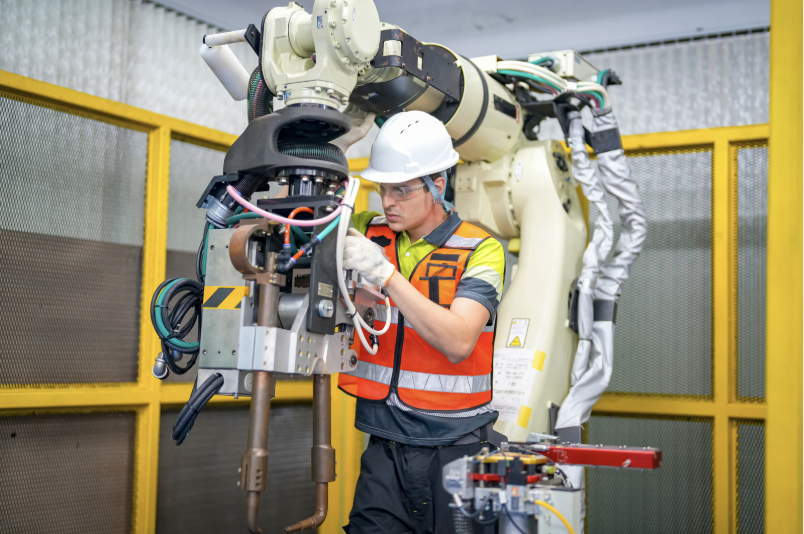
Robotic process automation has established itself as one of the most accessible and immediately impactful automation technologies available to Irish businesses. Unlike more complex AI implementations that require significant data preparation and model training, RPA can be deployed against existing processes with relatively modest upfront investment, and in the right contexts, it delivers measurable results […]
Robotic process automation has established itself as one of the most accessible and immediately impactful automation technologies available to Irish businesses. Unlike more complex AI implementations that require significant data preparation and model training, RPA can be deployed against existing processes with relatively modest upfront investment, and in the right contexts, it delivers measurable results quickly. For Dublin’s business community, where the pressure to improve operational efficiency is constant, RPA has become a practical first step in the automation journey.
The key to realising RPA’s potential is understanding where it delivers genuine value and where it does not. RPA is not a universal solution, it excels in specific contexts and struggles in others. Irish companies that have achieved the strongest RPA outcomes are those that have been disciplined about process selection, focusing their initial deployments on the areas where the technology’s strengths align most closely with the business need.
Overview of Robotic Process Automation in Ireland
RPA adoption in Ireland has accelerated significantly across financial services, insurance, healthcare administration, and professional services. Dublin’s concentration of large-scale back-office operations, in banking, insurance, and shared services, has made it a particularly fertile environment for RPA deployment. Irish businesses are using RPA to automate everything from data entry and report generation to compliance checking and customer onboarding.
The most successful RPA programmes in Ireland are those that are treated as strategic initiatives rather than isolated technology projects, with clear governance, defined success metrics, and a roadmap for expanding automation as initial deployments prove their value.
Repetitive Tasks Are Easiest to Automate
The processes that deliver the fastest and most reliable RPA results are those characterised by high volume, low variability, and clear rules. Data entry, invoice processing, report generation, and system-to-system data transfer are all examples of tasks that RPA can handle with high accuracy and minimal supervision. These processes are “easiest to automate” not because they are technically simple, but because their predictability makes them well-suited to the rule-based execution model that RPA employs.
For Irish businesses beginning their RPA journey, starting with these high-volume, repetitive processes provides the quickest path to demonstrable value. Early wins build organisational confidence in automation and generate the momentum needed to expand the programme.
Back-Office Workflows Show Quick ROI
Back-office functions, accounts payable, payroll processing, compliance reporting, HR administration, are among the most consistently productive areas for RPA deployment in Irish companies. These functions are characterised by large volumes of structured, rule-based work that is currently performed manually by skilled employees who could be contributing more value elsewhere.
The ROI from automating back-office workflows is typically rapid and measurable. Processing times are reduced, error rates fall, and the employees previously performing these tasks can be redeployed to higher-value activities. For Dublin’s financial services and professional services firms, where back-office efficiency is a direct driver of profitability, these outcomes are highly significant.
Standardised Processes Improve Results
The quality of RPA outcomes is directly correlated with the quality of the underlying process. Standardised processes, those with clear, consistent rules and minimal exceptions, produce the best automation results. When a process has high variability or relies heavily on human judgement, RPA struggles to handle the full range of scenarios it encounters, leading to exceptions that require manual intervention and eroding the efficiency gains the automation was intended to deliver.
Investing in process standardisation before RPA deployment is therefore not just a preparatory step, it is a value-generating activity in its own right. Organisations that standardise their processes as part of the automation programme consistently achieve better automation outcomes than those that automate existing, variable processes without modification.
How Dev Centre House Implements RPA Solutions
At Dev Centre House Ireland, we work with businesses across Dublin to identify, design, and implement RPA solutions that deliver genuine operational value. Our approach begins with a structured process assessment to identify the highest-value automation opportunities, followed by a disciplined implementation programme that includes process standardisation, bot development, testing, and ongoing support.
Conclusion
RPA delivers immediate value for Irish companies when it is deployed against the right processes, repetitive, rule-based, high-volume workflows where the technology’s strengths align with the business need. For Dublin’s business community, the opportunity to automate back-office functions, standardise processes, and redeploy skilled employees to higher-value activities is both significant and accessible. The key is starting with discipline: selecting the right processes, standardising them, and measuring the outcomes rigorously.
FAQs
What types of processes are best suited to RPA?
High-volume, repetitive, rule-based processes with low variability and structured data inputs are the strongest candidates for RPA. Examples include invoice processing, data entry, compliance reporting, and system-to-system data transfer.
How quickly can RPA deliver ROI?
For well-scoped deployments targeting high-volume processes, RPA can typically demonstrate measurable ROI within three to six months of deployment.
What is the difference between RPA and AI automation?
RPA automates rule-based, structured processes by mimicking human interactions with software. AI automation uses machine learning to handle more complex, variable tasks that require pattern recognition and decision-making beyond simple rules.
Why is process standardisation important before RPA deployment?
Standardisation ensures that the process being automated is consistent and predictable, which is essential for RPA to execute reliably. Automating a variable process without standardisation leads to high exception rates that undermine efficiency gains.
How does Dev Centre House approach RPA implementation?
Dev Centre House conducts a structured process assessment to identify the highest-value automation opportunities, then implements a disciplined programme that includes process standardisation, bot development, testing, and ongoing support.