The rapid advancement of artificial intelligence (AI) and machine learning (ML) has opened new opportunities for developers using Node.js. While Python has traditionally dominated the AI space, JavaScript powered by Node.js is making significant strides in the ML ecosystem. Thanks to a growing number of AI focused libraries, Node.js developers can now build intelligent applications without switching to another programming language. In […]
The rapid advancement of artificial intelligence (AI) and machine learning (ML) has opened new opportunities for developers using Node.js. While Python has traditionally dominated the AI space, JavaScript powered by Node.js is making significant strides in the ML ecosystem. Thanks to a growing number of AI focused libraries, Node.js developers can now build intelligent applications without switching to another programming language.
In this article, we explore seven powerful libraries that enable AI and ML development in Node.js, helping you create smart applications with ease.
1. TensorFlow.js – Google’s AI Framework for JavaScript
TensorFlow.js is one of the most well-known machine learning libraries for JavaScript, allowing developers to run ML models directly in the browser or Node.js. It supports training models from scratch or using pre-trained models for tasks like image recognition, natural language processing (NLP), and more.
Key Features:
Supports both CPU and GPU acceleration for high-performance computation.
- Can run pre-trained models from TensorFlow.
- Enables real-time inference in browsers and Node.js.
- Provides APIs for building, training, and deploying ML models.
Use Case: Real-time image classification in a Node.js application.
2. Brain.js – Simple Neural Networks for Node.js
Brain.js is a lightweight and beginner-friendly AI library designed for creating neural networks in Node.js. It offers a simple interface for training AI models using different architectures, including feedforward networks and recurrent neural networks (RNNs).
Key Features:
- Supports GPU acceleration for faster computations.
- Easy-to-use API for training and running models.
- Suitable for pattern recognition, forecasting, and classification tasks.
Use Case: Predicting stock market trends using past data.
3. Synaptic – Flexible Neural Network Framework
Synaptic is another neural network library for Node.js, designed for both beginners and advanced users. Unlike Brain.js, it provides more control over network structures, allowing developers to fine-tune models for various AI applications.
Key Features:
- Fully architecture-free, allowing custom neural network designs.
- Can train models using supervised and unsupervised learning.
- Works with both client-side (browser) and server-side (Node.js) applications.
Use Case: Building chatbots with AI-powered response generation.
4. Natural – NLP Library for Node.js
For developers focusing on natural language processing (NLP), Natural is a must-have library. It provides powerful text analysis tools, including tokenization, stemming, and classification.
Key Features:
- Supports various text-processing algorithms, including Naïve Bayes classification.
- Offers word stemming, phonetics, and string similarity comparisons.
- Works well with chatbots, search engines, and sentiment analysis.
Use Case: Creating a sentiment analysis tool for customer feedback.
5. Brain.js vs. Synaptic – Which One to Choose?
Both Brain.js and Synaptic offer neural network functionalities in Node.js. However, choosing the right one depends on your needs:
| Feature | Brain.js | Synaptic |
|---|---|---|
| Ease of Use | ✅ Beginner-friendly | ⚡ More flexible, but complex |
| Performance | 🚀 GPU acceleration | ⚡ Custom optimizations |
| Use Case | Simple predictions, pattern recognition | Advanced AI models, chatbots |
| If you want quick results with minimal setup, go for Brain.js. If you need more control, Synaptic is a better choice. |
6. ML.js – A Comprehensive Machine Learning Toolkit
ML.js is an all-in-one machine learning toolkit for JavaScript and Node.js, offering a wide range of statistical and ML algorithms. It’s perfect for projects requiring data processing, regression models, and clustering.
Key Features:
- Includes decision trees, k-means clustering, PCA, and regression models.
- Offers data transformation tools for preprocessing.
- Simple API for integrating ML into existing Node.js projects.
Use Case: Classifying customer data for targeted marketing campaigns.
7. Compromise – Lightweight NLP for Quick Text Processing
If you’re looking for an efficient and lightweight NLP solution, Compromise is a great alternative to Natural. It’s optimized for speed and is particularly useful for real-time applications requiring quick text analysis.
Key Features:
- Super-fast text processing for large datasets.
- Supports named entity recognition (NER) and text parsing.
- Works efficiently in server-side and client-side applications.
Use Case: Extracting names, dates, and locations from user-generated content.
Final Thoughts: Choosing the Right AI Library for Node.js
Node.js has come a long way in supporting AI and machine learning applications. Whether you’re building chatbots, recommendation systems, or predictive analytics, these seven libraries offer the tools needed to bring AI capabilities to your Node.js projects.
| Library | Best For |
|---|---|
| TensorFlow.js | Deep learning, real-time AI in browsers |
| Brain.js | Quick neural network implementations |
| Synaptic | Advanced neural network architectures |
| Natural | NLP tasks like sentiment analysis and classification |
| ML.js | Data science and statistical ML models |
| Compromise | High-speed NLP processing |
| By choosing the right library based on your project’s needs, you can leverage the power of AI and ML in Node.js to build intelligent, high-performing applications. |
Node.js: Key Takeaways from Dev Centre House Ireland
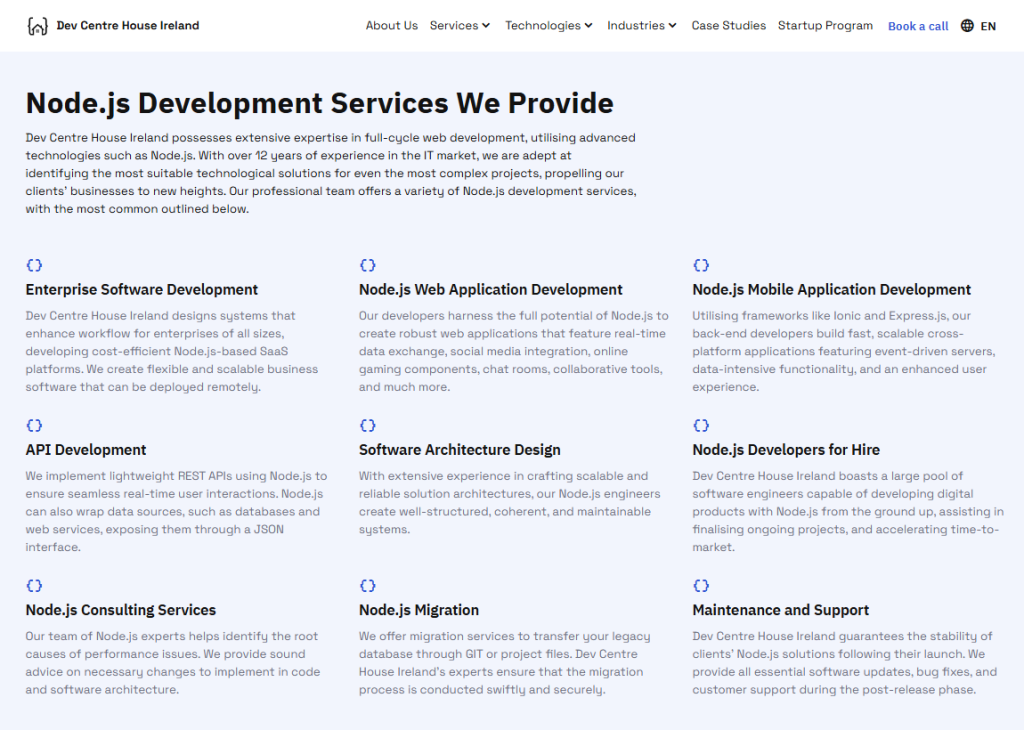
In conclusion, Node.js stands out as a powerful and versatile runtime environment for building scalable and high-performance backend applications. Its event-driven, non-blocking architecture, coupled with the vast npm ecosystem, enables developers to create efficient and responsive solutions. Whether you’re building real-time applications, APIs, or microservices, Node.js offers a robust foundation for modern web development, making it a valuable asset in any developer’s toolkit.
For further exploration and learning, refer to the detailed information provided in the resource: https://www.devcentrehouse.eu/en/technologies/back-end/nodejs.