Understanding the distinctions between Middleware, Guards, and Interceptors in NestJS is essential for writing clean, scalable, and maintainable applications. Although they might seem similar at first glance, each of these components has a unique role in the request-response lifecycle.In this post, we’ll explore the differences, use cases, and when to use what in your NestJS application. What is Middleware in NestJS? […]
Understanding the distinctions between Middleware, Guards, and Interceptors in NestJS is essential for writing clean, scalable, and maintainable applications. Although they might seem similar at first glance, each of these components has a unique role in the request-response lifecycle.
In this post, we’ll explore the differences, use cases, and when to use what in your NestJS application.
What is Middleware in NestJS?
Middleware functions are called before the request reaches the route handler. Think of them as the “gatekeepers” of HTTP requests. Middleware can modify the request and response objects and decide whether or not the request should continue through the pipeline.
Common Use Cases for Middleware
- Logging incoming requests
- Request validation or sanitisation
- Authentication token parsing
- Applying CORS or security headers
Example
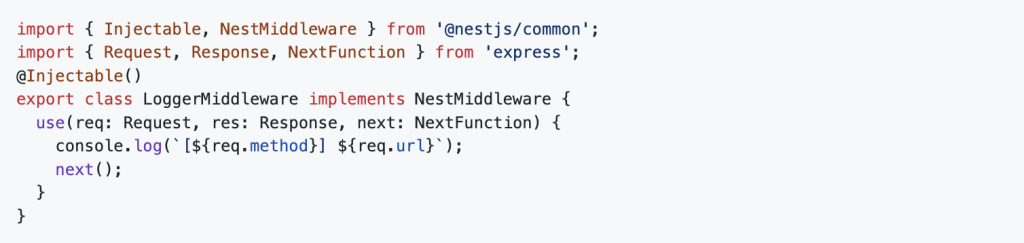
This middleware logs every incoming request. Middleware is typically applied in main.ts or a module file using configure() method.
What are Guards in NestJS?
Guards come after Middleware in the lifecycle and are used for authorization and access control. They determine whether a user can proceed to a specific route or not.
Guards return true or false (or throw exceptions) and are often used with roles and permissions.
Common Use Cases for Guards
- Role-based access control
- Route protection
- JWT verification
- Multi-tenant checks
Example
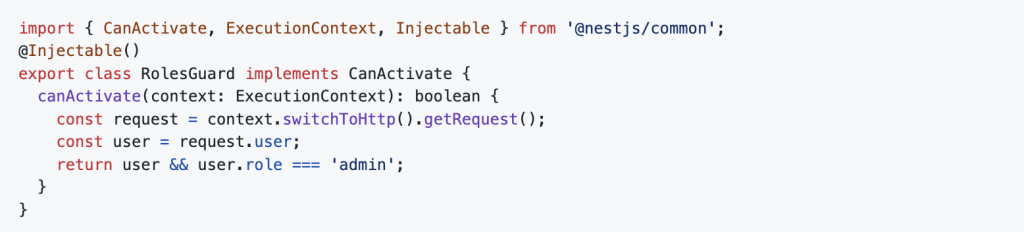
Apply it using @UseGuards(RolesGuard) on routes or controllers.
What are Interceptors in NestJS?
Interceptors sit after guards and are used for manipulating the request or response, logging, transformation, or even retry logic. They wrap around the method execution and can be used to transform the result, measure performance, or implement caching.
Common Use Cases for Interceptors
- Transforming responses (e.g., exclude sensitive data)
- Logging and metrics
- Error formatting
- Timeout and retry logic
Example
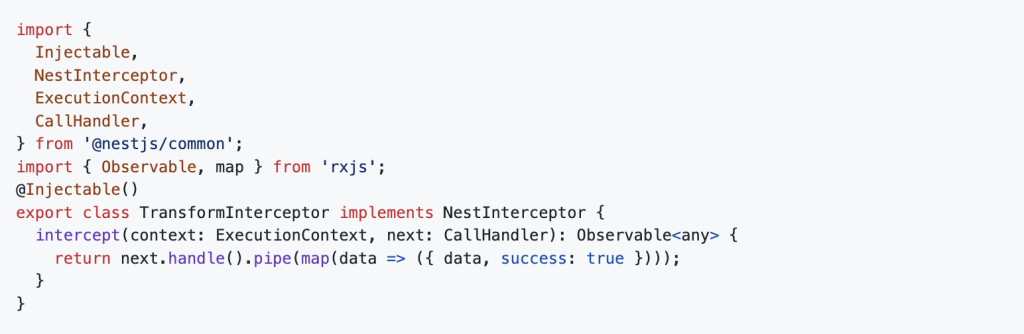
This interceptor wraps the response in a consistent format.
Lifecycle Order: Middleware → Guard → Interceptor → Controller
To clarify the flow:
- Middleware runs first — modifies the request object if needed.
- Guards evaluate permissions and access.
- Interceptors intercept and optionally modify the method execution or its result.
- Controller handles the final logic of the request.
Understanding this flow is crucial for placing logic in the right place.
When to Use What?
| Feature | Purpose | Runs When | Best For |
|---|---|---|---|
| Middleware | Pre-process request | Before reaching controllers | Logging, parsing, headers |
| Guards | Authorisation | Before route execution | Permissions, roles, access logic |
| Interceptors | Transform, log, handle responses | Before & after method execution | Response shaping, error handling |
| Each component serves a distinct purpose. Use middleware for broad concerns, guards for access control, and interceptors for response manipulation or performance logging. |
Final Thoughts

Knowing the difference between NestJS Middleware vs Guards vs Interceptors is key to writing clean and efficient backend logic. Use them strategically to build secure, well-structured applications that are easy to maintain and scale.
To further enhance your NestJS backend, check out how professional teams build Node.js backends at Dev Centre House Ireland.
FAQ
Question: What are the primary differences between Middleware, Guards, and Interceptors in NestJS?
Answer: Middleware is used for tasks like logging and request transformation before a route handler. Guards determine whether a request should proceed based on conditions like authentication. Interceptors handle tasks like response transformation or request timeout management after route handling.
Question: When should you use Middleware in NestJS?
Answer: Use Middleware for operations that need to happen before reaching the controller, such as logging, validation, or attaching data to the request. Dev Centre House Ireland uses Middleware effectively for request tracking and preprocessing tasks.
Question: What is the purpose of Guards in NestJS applications?
Answer: Guards act as gatekeepers. They are ideal for role-based access control and authentication logic, ensuring only authorised users can access certain routes. Dev Centre House Ireland implements Guards to secure enterprise applications.
Question: How do Interceptors help in building scalable apps?
Answer: Interceptors are great for wrapping around method execution and can help with logging, transformation, caching, and timeout logic. At Dev Centre House Ireland, Interceptors are often used to streamline API responses for scalable systems.
Question: Can these tools be combined in a NestJS application?
Answer: Yes, Middleware, Guards, and Interceptors are not mutually exclusive. They can and should be combined strategically to create well-structured, maintainable backend applications.
Question: Which layer runs first in the request lifecycle?
Answer: Middleware runs first, followed by Guards, and then Interceptors during request and response flow.
Question: How does Dev Centre House Ireland approach backend scalability using these tools?
Answer: Dev Centre House Ireland leverages Middleware for efficient request handling, Guards for strict access control, and Interceptors for streamlined data management, making apps more secure, maintainable, and scalable.