Okay, so we all know blockchain is getting bigger, right? But the problem is, it’s kinda slow when everyone wants to use it. We need to figure out how to make it handle millions of transactions every second without messing up security or making it less decentralized. Let’s look at five cool ways people are […]
Okay, so we all know blockchain is getting bigger, right? But the problem is, it’s kinda slow when everyone wants to use it. We need to figure out how to make it handle millions of transactions every second without messing up security or making it less decentralized. Let’s look at five cool ways people are trying to fix this.
1. Layer 2 Scaling Solutions
Basically, these solutions do the work somewhere else and then just tell the main blockchain what happened.
Examples:
- Ethereum: They’re using Rollups, like Optimistic and ZK-Rollups, to make things faster.
- Bitcoin: The Lightning Network lets you do quick, cheap little payments.
Benefits
- Stops the main blockchain from getting too crowded.
- Makes transactions cheaper.
- Speeds everything up.
2. Sharding
Imagine breaking the blockchain into smaller pieces so they can all work at the same time. That’s sharding.
Examples:
- Ethereum 2.0: They’re using sharding to make a massive jump in how many transactions they can handle.
- Polkadot: They have these things called parachains, which are like little side blockchains that work together.
Benefits
- Lets the blockchain grow bigger without slowing down.
- Makes things quicker.
- Makes the whole network work better.
3. Sidechains and Plasma
Sidechains are like separate blockchains that are connected to the main one, and Plasma chains handle transactions off the main chain and then just report back every now and then.
Examples:
- Polygon (MATIC): It makes Ethereum transactions super fast and cheap.
- Liquid Network: It’s a Bitcoin sidechain that helps big financial companies do stuff faster.
Benefits
- Speeds up transactions a lot.
- Takes some of the load off the main blockchain.
- Lets the network do way more transactions.
4. DAG-Based Blockchains
Instead of using the usual blockchain, these use something called a Directed Acyclic Graph (DAG), which lets transactions happen at the same time.
Examples:
- IOTA: They use something called Tangle, which is a DAG, so you don’t have to pay fees and it’s super scalable.
- Nano: They use a block-lattice thing that makes transactions almost instant.
Benefits
- Gets rid of those bottlenecks where everything has to wait in line.
- Can handle way more transactions.
- Uses less energy.
5. Consensus Mechanism Innovations
People are coming up with new ways to check transactions that are faster and better.
Examples:
- Proof of Stake (PoS): Ethereum 2.0 and Cardano use this, and it’s faster and uses less energy.
- Delegated Proof of Stake (DPoS): EOS and TRON use this to handle a ton of transactions.
Benefits
- Uses way less energy than the old Proof of Work.
- Makes transactions happen faster.
- Keeps the network safe without needing a ton of computers.
Navigating Blockchain Technologies with Dev Centre House Ireland
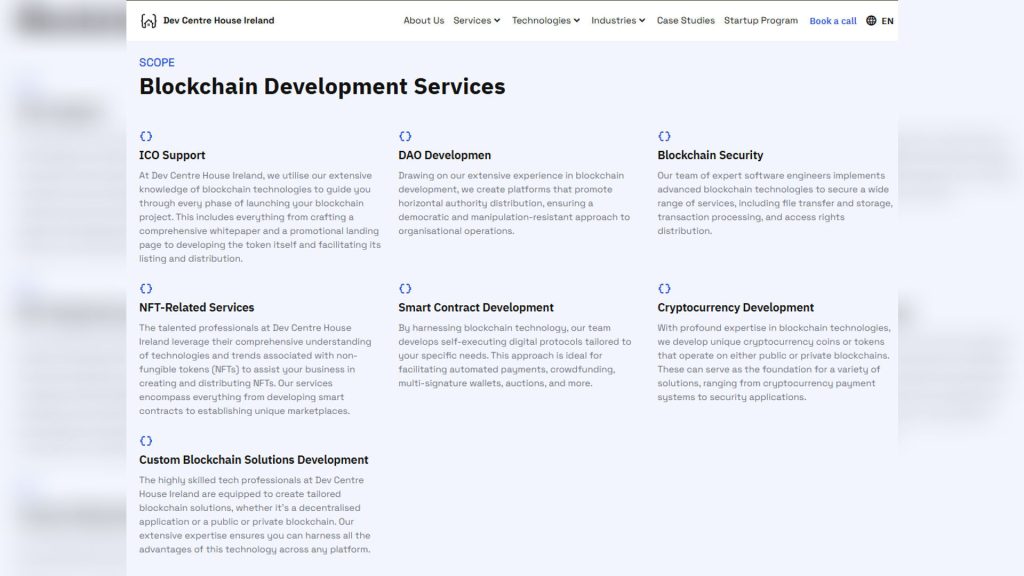
Basically, if blockchain is going to be used by everyone, we need to make it faster. These Layer 2 solutions, sharding, sidechains, DAGs, and new ways to check transactions are all helping to make that happen. As these technologies keep getting better, blockchain will be able to handle millions of transactions without a problem, and that’s going to change everything. For expert assistance in navigating these complex blockchain solutions and building scalable applications, consider partnering with professionals at Dev Centre House Ireland.
FAQ
Question: What scalability challenges do blockchain networks face?
Answer: Popular blockchain networks like Ethereum and Bitcoin often struggle with low transaction throughput, high latency, and rising fees as user demand increases. Scalable solutions are essential to support mass adoption.
Question: What are layer‑2 solutions, and how do they improve blockchain scalability?
Answer: Layer‑2 solutions, like rollups and state channels, process transactions off the main chain and settle them in batches, significantly increasing speed and reducing cost while maintaining security.
Question: How do rollups work for blockchain scaling?
Answer: Rollups bundle multiple transactions off‑chain, generate proofs, and submit them on the main blockchain, multiplying capacity without compromising decentralisation.
Question: What are state channels, and when should they be used?
Answer: State channels let users conduct many transactions off‑chain instantly and settle results making them ideal for high-frequency use cases like microtransactions or gaming.
Question: What trade‑offs come with layer‑2 scaling methods?
Answer: Improvements in speed and cost may come at the expense of slightly longer finality times or more complex architecture—but these are manageable with good design.
Question: How does sidechain scaling differ from layer‑2 solutions?
Answer: Sidechains run separate blockchains with their own rules and token economics; they offer flexibility but require more trust than layer‑2 methods anchored to a main network.
Question: Can sharding help blockchain networks scale?
Answer: Yes, sharding splits the blockchain into parts (shards) to enable parallel transaction execution, greatly increasing throughput—though it introduces complexity in consensus and data management.
Question: How do modular blockchains support scalability?
Answer: Modular architectures separate execution, consensus, and data availability layers—allowing each to scale independently and combine for powerful performance gains.
Question: Are Layer‑2 solutions secure?
Answer: Absolutely. Solutions like optimistic rollups and zk‑rollups incorporate fraud proofs or zero‑knowledge proofs, providing strong security guarantees linked to the mainchain.
Question: How should businesses choose the right scaling technique?
Answer: Businesses should evaluate factors like transaction volume, speed, security needs, and complexity tolerance to select the most suitable solution.
Question: How can Dev Centre House Ireland help with blockchain scalability?
Answer: We design and implement scalable, secure blockchain systems, including integration of rollups, sidechains, and sharding strategies to support your growth goals.
Question: Will scalable blockchain solutions support enterprise growth?
Answer: Yes. By boosting capacity and reducing costs, scalable solutions enable enterprises to deploy blockchain tech in finance, supply chains, gaming, and more.
Question: What companies benefit most from blockchain scaling?
Answer: Use cases with high transaction volume, like payment processors, exchanges, gaming platforms, and large-scale NFT projects- see the most obvious benefits.
Question: How does scalability impact user experience?
Answer: Faster transactions and lower fees result in smoother user journeys and higher retention, critical for mainstream adoption and sustained engagement.